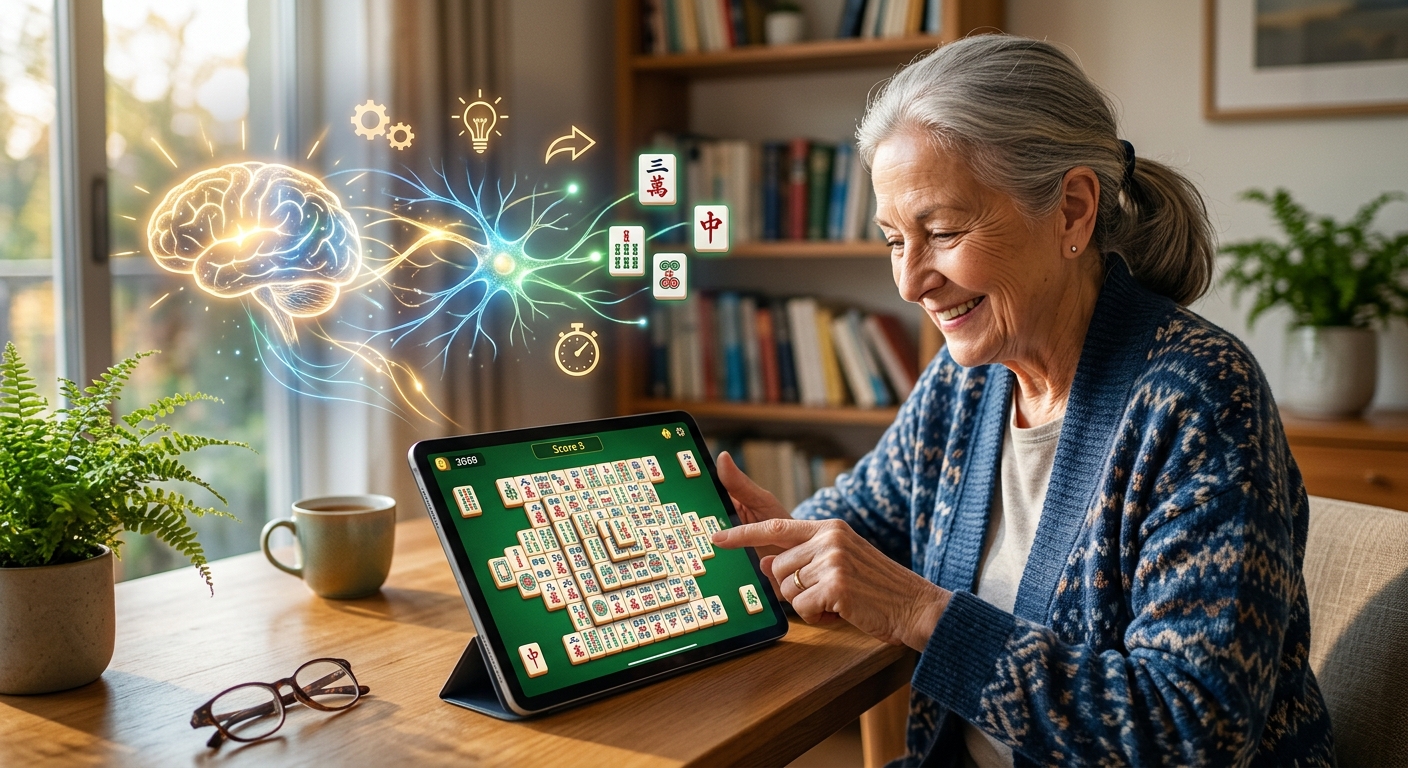
Most people open Mahjong Solitaire to unwind. They click a few tiles, zone out a little, and suddenly twenty minutes have passed. But something more interesting is happening underneath that relaxed surface. The brain is working, actively and purposefully, in ways that carry over into everyday life. That is the quiet power of a good puzzle game.
Mental Edge: What Short Puzzle Games Actually Do for Your Brain
- Mahjong Solitaire exercises pattern scanning, a skill that transfers directly to real-world focus tasks.
- Forward planning on a tile layout builds working memory without feeling like a chore.
- Daily challenge formats create low-pressure habit loops that keep the brain engaged consistently over time.
- Fast dice and card games work the same quick-decision muscles from a completely different angle.
- A light daily puzzle routine does not need to be long to produce genuine cognitive benefits.
The Quiet Workout Hidden Inside a Tile Game
Mahjong Solitaire looks simple. A stack of tiles sits in front of you. You find matching pairs and remove them. The board empties. You win.
But that description misses everything that actually happens. Before you click a single tile, your eyes are already scanning the layout. You are cataloguing what is exposed, what is buried, and what might become available if you clear a specific area first. That mental process, repeated hundreds of times per session, is not trivial. It is genuine cognitive exercise.
Games requiring sustained attention and pattern recognition activate the same neural pathways involved in complex problem-solving. The challenge does not have to be difficult to be effective. It has to be active, specific, and just a little demanding. Mahjong Solitaire fits that description precisely.
What Pattern Scanning Really Means for Your Brain
Pattern scanning is the skill of identifying relevant information inside a cluttered visual field. It is what a radiologist uses reading a scan, what an editor uses skimming a page, and what a driver uses watching traffic. It is also exactly what you use every time you look at a Mahjong Solitaire board.
The tile layouts in Mahjong Solitaire are deliberately complex. Classic formations like the Turtle stack tiles four layers deep in places, with hundreds of individual pieces visible at once. Your job is not to stare at every tile. Your job is to filter out the noise and lock in on what matters: pairs that are currently free to move.
The more you play, the faster that filter works. Your eyes learn where to look. Your brain learns which cues signal a free tile versus a locked one. That is a real, trainable skill, and it sharpens with repetition.
Research on working memory shows that the brain holds a limited number of items in active focus at any given moment. Puzzle games like Mahjong Solitaire train you to use that limited space efficiently. You learn to hold only the most relevant information and let the rest fall away.
Forward Planning Without the Paralysis
Here is where Mahjong Solitaire gets genuinely strategic. Removing any two matching tiles feels like progress. But removing the wrong pair can lock you out of a win entirely. The game constantly forces a question: is this the right move, or does it close off something I need later?
That kind of forward planning is harder than it sounds. Most people naturally focus on what is immediately available. Thinking two or three moves ahead requires an extra layer of attention. Mahjong Solitaire builds that layer without you noticing it.
Specific layout designs push this thinking further. The Dragon layout spreads tiles in long chains where one end depends on clearing the other. A player who only reacts to what is visible right now will get stuck. A player who reads the chain first and plans a clearing order will finish the board smoothly.
That is strategic patience in practice. And strategic patience is a skill that applies far beyond tile games.
How Daily Challenges Turn a Game Into a Habit
Single games are fun. Daily challenges are transformative.
A daily challenge is the same board given to every player on a given day, with a fixed layout that resets at midnight. It introduces two things that casual play does not have: consistency and a reference point.
Consistency means your brain encounters a puzzle task at roughly the same time each day. That regularity helps establish a habit loop. The brain begins to expect the challenge and arrives at it already primed. Over weeks, returning to the daily board starts to feel less like a choice and more like a ritual.
Here is what makes the daily challenge format particularly effective for building cognitive habits:
- The time constraint is self-imposed, which reduces anxiety and keeps the session light.
- Repeating the same format daily lets players track genuine improvement over time.
- A shared board creates a sense of community without requiring real-time interaction.
- Finishing the challenge gives a clear sense of completion, which reinforces the habit loop.
That last point matters more than it seems. Closure is motivating. A puzzle with a definite end feels satisfying in a way that open-ended tasks rarely do. That satisfaction is part of what brings players back the next day.
Calm Under Pressure Is a Learnable Skill
Mahjong Solitaire can create pressure. A timer ticks. The board starts to look impossible. A few wrong moves ago you had options, and now you have fewer. The natural response is to rush, to click faster, to try anything.
Players who have spent real time with the game learn a different response. They pause. They scan again. They look for the move they missed rather than repeating the moves they already know will not work. That shift, from reactive clicking to deliberate assessment, is calm under pressure in a very real sense.
This is not just a game skill. The same cognitive pattern applies to any situation where time pressure and limited options collide. The brain learns a template: when things feel stuck, pause and re-scan before acting. Puzzle games are a low-stakes environment to rehearse that template until it becomes automatic.
Other Fast Games That Exercise the Same Mental Muscles
Mahjong Solitaire is not the only game that builds these habits. The combination of fast decisions, pattern recognition, and light planning shows up across several formats. Here is a useful sequence for thinking about how different game types build the same underlying cognitive toolkit:
- Tile matching games (like Mahjong Solitaire): Build visual pattern scanning and forward planning through spatial reasoning on a fixed layout.
- Dice-based scoring games: Train probabilistic thinking and fast value assessment under real-time constraints, where no two rounds look the same.
- Card layout games: Develop sequencing logic and working memory through ordered decision trees with shifting available options.
- Word puzzles: Strengthen lexical retrieval speed and associative thinking under mild time pressure.
- Number-grid games: Reinforce logical deduction and elimination reasoning in a structured, visual format.
The dice-based category is worth pausing on. Games in that space ask players to read a random outcome, assess its value across multiple scoring categories, and commit to a choice, all within a matter of seconds. That is a genuinely different cognitive demand from spatial tile matching, but it exercises the same underlying muscle: making good decisions fast with incomplete information.
If you want to mix formats and keep your brain working from a different angle, you can always play qwixx between Mahjong sessions. It is a clean, fast dice game that pushes quick-decision thinking in a completely different direction while still fitting neatly into a short daily routine.
What Tile Layouts Teach You About Your Own Thinking Style
One underappreciated benefit of playing multiple layout formats is what they reveal about how you naturally process information. Not every Mahjong Solitaire layout challenges the brain the same way, and where you struggle often points toward something worth noticing.
- Compact pyramid layouts reward players who think from the top down, clearing obstacles before targeting matches.
- Wide, flat layouts favor players who scan broadly and hold multiple potential pairs in mind simultaneously.
- Deep multi-layer stacks require patience and a longer planning horizon before the first move is even made.
Players who consistently struggle with one layout type and thrive on another are learning something real about their cognitive preferences. That kind of self-knowledge is genuinely useful. It points toward which mental skills feel natural and which ones could use more practice.
Building a Light Daily Puzzle Routine That Actually Sticks
The word routine can make something feel like a chore. A puzzle routine does not have to feel that way. The key is keeping the session short enough that it never competes with higher priorities, and varied enough that it does not turn into autopilot clicking.
A five-to-ten minute daily session is enough. That is genuinely sufficient to build pattern scanning habits and keep working memory sharp. The session does not need to be longer to be effective. Consistency over time matters far more than duration per session.
Start with the daily challenge. It takes a few minutes, gives you a clear result, and provides the closure that makes the habit feel complete. On days when you want more, add a second layout in a different format. On days when you are short on time, the daily challenge alone is enough.
The National Institute on Aging notes that keeping the brain active through varied, engaging tasks is one of the most accessible things a person can do for long-term mental sharpness. Their research on brain engagement as we age consistently points to active participation over passive entertainment. A ten-minute puzzle game counts as active participation. It asks something of you. That is the difference.
The games on this site are free, run in a browser, and require no signup. The barrier to starting is essentially zero. Every friction point in a routine is a reason to skip it. Remove the friction, and the habit becomes the path of least resistance.
The Small Habit With a Larger Payoff
None of this requires believing that puzzle games will dramatically change your cognitive capacity overnight. The claim is simpler and more honest than that. A short daily puzzle session, done consistently, trains specific cognitive habits: pattern scanning, forward planning, and calm decision-making under mild pressure.
Those habits are useful. They transfer. And they build quietly, in the background of what feels like a simple game.
Mahjong Solitaire earns its place in that routine because it combines all three cognitive demands in a format that is genuinely enjoyable and takes only minutes. Add a fast dice game on the side for variety. Keep the sessions short. Come back tomorrow.
That is the whole routine. And it turns out to be enough.