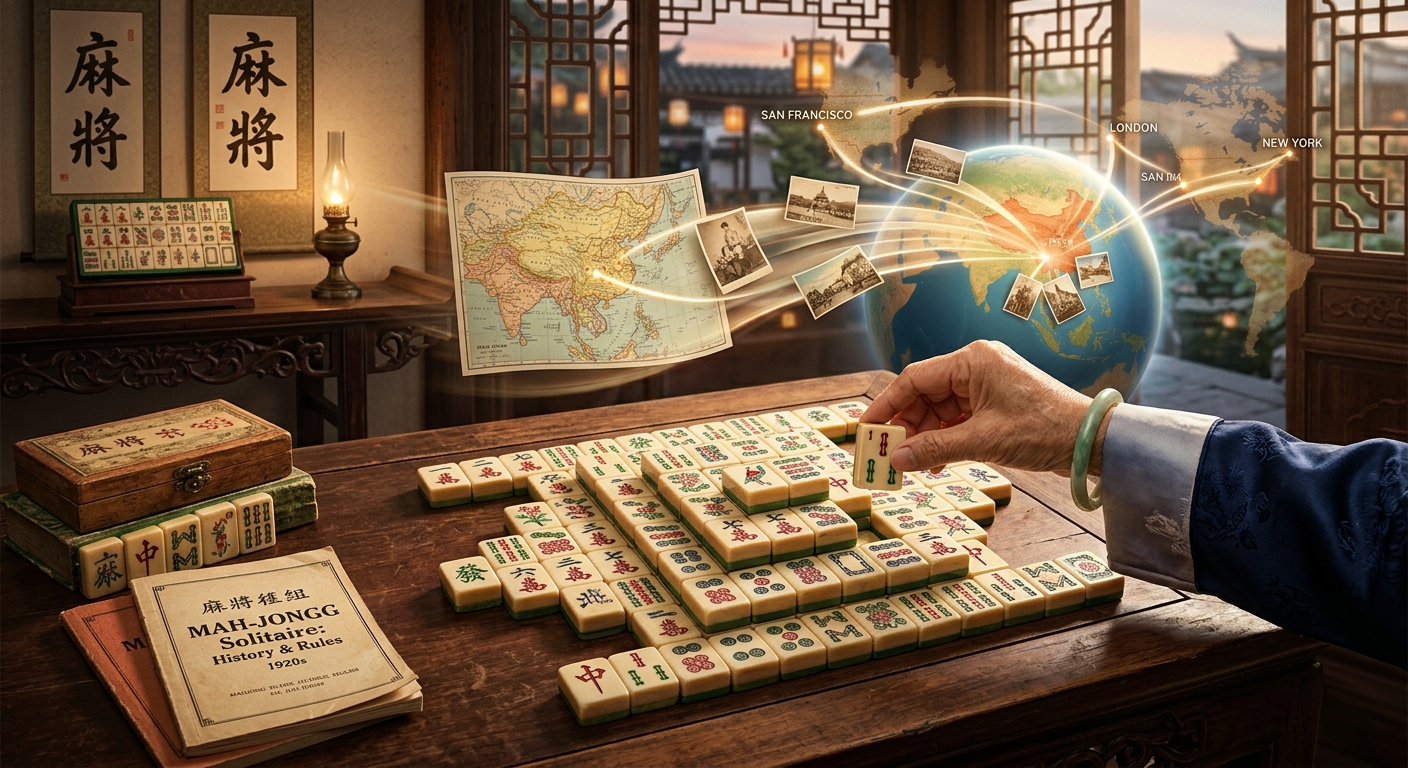
A pair of bamboo tiles disappears, and a hidden dragon comes into view. That small moment on your screen belongs to a much bigger story. Before Mahjong became a browser puzzle, its tiles passed between friends, relatives, travelers, and neighbors. People carried the game across borders. New communities changed its rules and made room for it in their own social lives. Computers eventually gave those familiar tiles a different job: forming a puzzle that one person could solve.
Three Turns in Mahjong’s Story
- Mahjong developed in 19th-century China as a social tile game.
- Communities abroad adapted its rules and built lasting playing traditions.
- Computer games turned its tiles into the matching puzzles played in browsers today.
Mahjong Began With People Around a Table
Mahjong’s documented roots lie in 19th-century China. Its development is generally associated with the Yangtze River Delta, including the area around Shanghai. The precise story is less tidy than a single inventor sitting down with a finished set. Earlier Chinese card and tile games helped provide the foundations. Rules and equipment developed through play.
Claims that Mahjong is thousands of years old make an appealing story, but they blur the distinction between older gaming traditions and Mahjong itself. The game we recognize took shape much more recently. That makes its worldwide reach striking. Within a few generations, a regional pastime became familiar far beyond its place of origin.
Traditional Mahjong usually brings four players together. They draw and discard tiles while trying to complete a winning hand. Players must understand combinations, watch discards, and judge what other people may need. Scoring varies between versions. The rhythm includes moments of calculation, surprise, and waiting for the next tile.
It also creates time for conversation. A regular game gives people a reason to meet and a shared activity to return to. The tiles matter, but the gathering matters too. That social function helps explain why Mahjong lasted after the excitement of learning something new wore off.
Travel and Trade Carried the Tiles Abroad
Mahjong spread through overlapping routes. Chinese migrants carried familiar customs into new homes. Travelers encountered the game and brought sets back with them. Merchants sold tiles, while publishers supplied instructions for people who had no experienced player nearby.
The international boom became especially visible in the early 1920s. American businessman Joseph Park Babcock helped market Mahjong to English-speaking audiences. His 1920 rulebook presented a simplified approach for newcomers. Commercial sets often added numbers or letters to make unfamiliar tile markings easier to read.
The Strong National Museum of Play’s historical collections document the sharp rise in American and European interest during that period. Mahjong became fashionable in drawing rooms and social gatherings. Manufacturers and retailers rushed to meet demand. A game learned through personal contact could now arrive in a box with printed instructions.
That packaging helped the game travel, but it also changed how people understood it. Western advertising sometimes wrapped Mahjong in exaggerated ideas about China. Its real history was more human. Players taught friends, argued over rules, and worked out how a regular session would fit into their lives.
The commercial craze did not stay at its initial height. Lasting communities of players did. Their habits gave Mahjong a future beyond fashion.
New Communities Made Mahjong Their Own
A traveling game rarely keeps every rule unchanged. People choose versions that suit their gatherings. They teach the rules they know, adopt local preferences, and pass those choices to the next group of beginners. Mahjong’s history contains many examples of that process.
In China, regional forms developed different approaches to scoring, permitted hands, and special tiles. A player familiar with one version may need an explanation before joining another group. The shared tile language helps, but agreeing on the rules remains part of sitting down to play.
Japan developed a strong tradition around riichi Mahjong. Its declaration of readiness and distinctive scoring rules create their own tactical rhythm. Clubs, family groups, and other playing communities provide settings where newcomers learn that rhythm from experienced players.
American Mahjong followed another path. The National Mah Jongg League records its founding in New York City in 1937, when enthusiasts gathered to standardize play. Its annual card of winning hands became central to that organized version of the game. Players gained a common reference they could bring to different tables.
Mahjong also became deeply rooted in many Jewish American social networks. Historian Annelise Heinz’s research examines how regular games helped women sustain friendships and build connections in changing communities. A recurring session could give newcomers a place to belong. Learning the game meant joining a circle of people as much as learning a set of hands.
Chinese American communities maintained their own Mahjong traditions too. These histories should not be reduced to one national story. Different groups could use related tiles while attaching different memories, rules, and routines to them.
Shared Games Take Root Through Social Rituals
Mahjong’s spread shows a pattern found in other culturally embedded pastimes. A game travels with people. Someone teaches it in a new setting. Local players adapt it, then turn it into a recurring part of social life.
Looking at world drinking games offers a brief parallel. Games associated with gatherings can circulate between countries and acquire local rules or customs. The connection is about how people share pastimes and make them familiar. It does not require the games to have the same origins, purpose, or mechanics.
For Mahjong, the ritual might mean a weekly afternoon, a family visit, or a club meeting. Those repeated occasions help a game survive. People return because they enjoy the challenge and because they expect to see familiar faces. A rulebook can explain a turn. A community gives someone a reason to take another.
Computers Gave Mahjong Tiles a New Role
Mahjong Solitaire belongs to this history, but it is a separate game. It uses Mahjong tiles to create a matching puzzle. There is no need to build a concealed hand or read an opponent’s discards. Instead, the challenge comes from deciding which available pair to remove.
A major early step came in 1981, when programmer Brodie Lockard created a computer tile-matching game on the PLATO system. Activision’s Shanghai, released in 1986, helped bring the format to home computer audiences. Its stacked tiles made the puzzle immediately recognizable.
The computer handled work that would be awkward with a physical set. It arranged the board, checked legal selections, and removed pairs. Players could concentrate on the pattern in front of them. A familiar collection of symbols became the basis for a new kind of spatial challenge.
That shift changed the experience. Traditional Mahjong depends on the movement of tiles between players’ hands and the table. Solitaire depends on access. A tile may be visible yet unavailable because another tile covers it or both sides are blocked.
How the Two Games Ask You to Think
| Feature | Traditional Mahjong | Mahjong Solitaire |
|---|---|---|
| Players | Usually four people | Usually one person per board |
| Main Goal | Complete a winning hand under agreed rules | Clear the layout by removing matching pairs |
| Main Decisions | Choose discards, pursue hands, and assess opponents | Choose pairs that open useful tiles and preserve options |
| Role of the Tiles | Form combinations with different scoring roles | Provide matching identities within a stacked layout |
Browser Play Made the Puzzle Easier to Share
As personal computers became common and internet access spread, Mahjong Solitaire gained more places to live. Browser versions removed the need for a boxed game or a separate installation. Someone could start a board during a break, return later, and send a friend toward the same kind of puzzle.
Mahjong.now continues that accessible format with free browser play and no signup or download required. Its eleven layout variations offer different arrangements of the same basic challenge. Daily challenges create a reason to return, while live multiplayer racing adds direct competition to individual board solving.
This restores a social layer in a different form. Players can compare completion times, share advice, and take part in a common routine. Racing still uses Solitaire mechanics. Each player solves a board rather than taking turns drawing and discarding tiles from a shared traditional game.
The worldwide journey has therefore changed both the rules and the setting. Mahjong moved through homes and clubs. Its Solitaire relative moved through computer screens and browsers. Both can bring people into repeated contact around a familiar activity.
Tile Traditions and Layouts Shape Your Next Move
The tile artwork preserves a visible connection to traditional Mahjong. Common sets contain dots, bamboo, and characters, along with winds and dragons. Flowers and seasons may appear too. Recognizing these families makes a crowded board easier to scan.
Start by separating the suits in your mind. A tile with three dots belongs to a different family from one with three bamboo marks. Then look at the number or symbol within that family. This reduces the chance of selecting two tiles that seem close at a glance but do not match.
Special tile groups deserve attention. Many Solitaire versions allow different flower tiles to pair with one another, and different season tiles to pair within their group. Follow the game’s matching rules rather than assuming every pair must show identical artwork. Those conventions reflect how a borrowed tile set has been adapted for puzzle play.
Layouts have a different history. Their shapes belong to Solitaire puzzle design rather than the arrangement of a traditional four-player hand. A tall central stack hides information. A wide layout creates more side edges to inspect. Narrow channels can keep tiles trapped until the right pair disappears.
Use those shapes to guide your decisions. Before removing a pair, check what each tile is blocking. A move that exposes a buried tile or opens a long row often provides more options than one that clears two isolated tiles. When several copies are available, compare the possible pairings before committing.
Mahjong.now’s guaranteed-solvable boards provide a route to completion from the starting position. That does not mean every legal move preserves that route. If a board stalls, examine which earlier choices reduced access. This makes replaying a layout useful practice, even when you already recognize its shape.
A Long Journey Behind Every Pair
The next time you open a board, its familiar symbols can mean a little more. They come from a social game shaped in China, carried abroad, and adapted by communities that made it part of everyday life. Computer designers later borrowed those tiles for a distinct puzzle, giving them another worldwide audience.
You do not need to memorize that history to enjoy playing. Let it help you notice what is on the screen. Learn the tile families. Pay attention to the layout’s blocked edges and covered layers. Treat each pair as a choice about what becomes available next. The game’s journey brought the tiles to your browser. Your next move gives that small board its own story.